
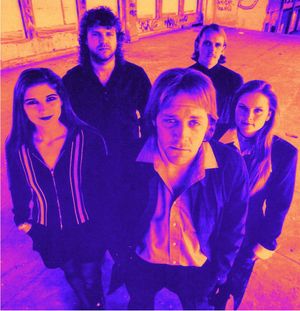
(Pictured: Brian Wurschum and Jude Kastle)
The Voyces were founded in New York City in 1999 by singer/songwriter/multi-instrumentalist, Brian Wurschum, along with his longtime singing partner Laurel Hoffman.
The name of the band was inspired by the 1981 song, The Voice, by The Moody Blues. For a brief period the name of the band was, The Voices. While making a flier in New York City’s East Village, ‘The Voyces’ was written accidentally. The band members decided the typo looked better and the name was officially adopted right then and there.
Before forming The Voyces, Wurschum and Hoffman performed together throughout the 1990’s in Wurschum's psychedelic indie band, majority DOG. Based in Southern-California, majority DOG released two official albums (Mr. Night, 1994, and Nevada, 1996). Wurschum and Hoffman also regularly performed together during that same time period as a folk duo called, Zelig, releasing one album under that moniker called, Race You to the Sun (1998).
In 2000, The Voyces’ song, Relate to Me, was featured in a Jack Johnson film and soundtrack, Thicker Than Water. The soundtrack was released in 2003, reaching #21 in the Billboard Soundtracks charts.
That same year, The Voyces appeared on The Late Show with David Letterman.
The Voyces’ first official release, The Angels of Fun, would also come in 2003. The album cover was supposed to be a photograph of seven models dressed like angels. After two photo shoots, both of which had only six models show up, the idea had to be scrapped due to production deadlines, and Wurschum quickly drew the album cover instead (Wurschum began illustrating almost daily and had a large showing of his works at The Luna Lounge in 2004).
Due to personal differences, Wurschum and Hoffman parted ways in 2004, thus ending their musical partnership of over fifteen years.
Despite a lack of any live activity, interest in the band continued to grow, due to the success of Jack Johnson’s Thicker Than Water.
In 2004, three songs were featured in a National Lampoon movie called, Adam and Eve.
In 2006, independent solo artist, Jude Kastle joined the group. Prior to this, Kastle had released Ghost of a Girl (2002), and Junkie For Fire (2004).
In 2005, Kastle was #3 in Maxim’s list of Best Indie Artists.
In 2007, the band signed with Planting Seeds Records and released, Kissing Like It’s Love. The album peaked at #3 on Barnes and Noble’s sales charts. That same year, the bands music would be featured in the Lifetime television show, Monarch Cove, as well as a Toyota commercial.
After several tours, the band went back to the studio and recorded, Let Me Die in Southern California (2009). A tour and official album release were planned, but canceled due to illness.
In 2018, Wurschum began recording instrumental blues/funk/jazz music, playing every instrument himself. He released three albums under the name, Looomis, (Long-Legged Highway, 2018, Butterscotch Village, and Sacred Geometry, both 2019).
In 2020, a filmmaker reached out to band members for talks of a possible majority DOG documentary.
Sadly, Laurel Hoffman took her own life in 2021.
In 2023, The Voyces began releasing old recordings and new music once again, including a live album, Live in 2008, and a compilation of the band’s most requested music called, Songs You Asked For.
In 2024, Brian Wurschum released his instrumental solo funk recordings on three different albums: Glossolalia, Looter, and Zyzxx.
In 2024, The Voyces released three brand-new singles, California Skies, Call It Home, and, That’s Why We Like It.
The Voyces are currently recording new music.

majority DOG and ZELIG
majority DOG was formed in 1988 by Brian Wurschum. It was originally a heavy metal band with no name and no singer. The music, written by Wurschum, was heavily inspired by Judas Priest, Dio, and The Scorpions. The songs contained lyrics, but finding a lead vocalist proved to be so difficult that Wurschum started writing songs inspired more by the likes of Pink Floyd and Simon and Garfunkel that he himself could maybe sing.
The name, majority DOG, came as the result of Wurschum’s behavior during an alcoholic blackout at a party one night. The following day, he would learn that for a while he’d run around some party with tape covering his eyes, angrily telling everyone, “Look at me! I can’t see anything! I’m just like the majority of the population!” A while later, Wurschum was found sitting silently on a couch with tape over his mouth. Whenever he was asked about it, he’d remove the tape and tell people he was now acting the part of an animal, who could see all kinds of things but was unable to talk. “I’m a dog now, get it?” As the party was ending, Wurschum walked around quietly repeating the words, “majority” and “dog.” Wurschum, a vegetarian at the time, explained that the way the majority DOG was spelled was meant to signify that animals were better than humans.
“The band name story is ridiculous and embarrassing,” Wurschum told Bill Locey of the Los Angeles Times in 1994, “but we kept right on using it because it worked. Needless to say, I’m glad I’ve stopped drinking.”
majority DOG, with Wurschum as vocalist, performed their first-ever concert on November 19th, 1989, in a parking lot adjacent to the 101 freeway, at the Borchard Road off-ramp, in Newbury Park, California.
That same winter, the group would record their debut album with well-known local musician and producer, Matt Chidgey. Wurschum, along with drummer, Scott Wilson, and bassist, Mike Blatt, would record seven songs – three of them, heavy metal instrumentals, and the others, Pink Floyd-style ballads on which Wurschum recorded his vocals for the very first time. The homemade, self-titled cassettes had the printing on the covers typed out using an actual typewriter each and every time the local record store would sell a copy.
Matt Chidgey passed away in 2010, in a freak drowning accident right near his home, during torrential rains.
During the earliest performances, Wurschum would invite a waitress he’d met at Denny’s to join him on stage to harmonize on one of his original songs, The Bird Above Me Does Not Fly. Her name was Laurel Hoffman.
Like Wurschum, Hoffman was a huge fan of Simon & Garfunkel, The Beatles, and King Crimson, and singing intricate harmonies came naturally to her. Aesthetically, the pair were diametrically opposed - Wurschum looked like a long-haired stoner, and Hoffman was quintessential goth from head to toe - something that would prove to be a major issue for many years to come. However, it was immediately obvious to both parties that together they created a unique sound when they sang, and there were talks of including Hoffman on future recordings, as she was not involved in the making of their first album.
On New Year’s Eve, 1989, Wurschum stayed up all night writing and recording roughly twenty acoustic songs the duo could sing together. However, Wurschum tried contacting Hoffman and found out she’d abruptly moved to France. Ads were put in the newspaper to replace her, and several people auditioned, but no one had the sound, or the ability, possessed by Hoffman.
Wurschum and Blatt, along with new drummer Scott Lombard, began to play in small venues from Ventura to Pasadena on a regular basis.
Meanwhile, word got back to Wurschum that Hoffman’s move to France had broken down. Rumor had it she’d gotten as far as Albany, New York, and, feeling lost and disillusioned, returned home.
“I went to see her,” Wurschum would tell The Ventura County Star in 1996, “and I said I thought we needed to sing together, that we should play live together as often as possible just to see what happened.” Wurschum had gotten completely sober by this time, and, not only did Hoffman agree to sing, she’d decided she’d stop drinking and using any drugs (a commitment made to herself that she would indeed honor) as long as they were singing together.
By 1991, majority DOG were performing concerts on a regular basis, with new members, Scott Swanson on bass, and Jason Dalbey behind the drums. Eventually, Laurel’s sister, April Hoffman, would join the group as well. The group became local favorites, becoming the house band at a bustling hang-out spot called, Lose The Blues, in Agoura Hills.
Aside from pairing up in majority DOG, Wurschum and Hoffman had started playing folk music together as a duo, calling themselves, Zelig, named after the Woody Allen film about a human chameleon, due to their uncanny ability to duplicate the sound of any artist they were covering. Performing as a pair also allowed them to perform far more concerts at more locations (between 1991 and 1999 alone, Wurschum and Hoffman would perform live over 4,800 times).
In 1992, majority DOG entered into a Battle of the Bands competition in Ventura. Considered to be the heavy underdog, the group competed against two bands who were local darlings in the press. In an upset that would cause feuds for years to come, majority DOG won. The prize was a block of recording time in a professional studio. There, they made a three-song cassette – the first ever recording of Wurschum and Hoffman singing together.
The tape quickly increased their popularity, and the group soon landed their first gig at a major venue called, The Ventura Concert Theatre. They opened for America. The venue was so impressed by the large amount of tickets sold by the openers, that they were invited to return to the venue many times, playing with groups like, Bush, Cracker, and, Big Bad Voodoo Daddy. Soon, majority DOG were regularly headlining places like, The Whiskey A Go-Go, and, The Roxy, on a regular basis.
By 1993, they had signed on with Ben Mclane as manager. Their music was being licensed to the WB Network, and they were performing in music festivals from California to New Orleans. Their music was featured on KLOS and KROQ in Los Angeles, as well as KTYD in Santa Barbara.
That same year, majority DOG recorded their debut album, Mister Night, with Mark Roum engineering, at A.C.E. Studios in Newbury Park. Stylistically, the record swayed back and forth between something bordering on heavy metal, and psychedelic folk rock. Their sound was the antithesis of the grunge movement popular at the time. Despite this, the group continued to amass a growing cult following, garnering the interest of producers Richard Dashut and Keith Olsen, of Fleetwood Mac fame.
The increasing momentum would lead to them becoming the first-ever rock band to perform at The Civic Arts Plaza, in Thousand Oaks. Venue management was reluctant to host any rock bands, and their decision to allow the group to play was controversial at the time. The event would have majority DOG predominantly featured in The Los Angeles Times, in January, 1995.
The sold-out concert went off without any issues, and the group was invited to return as often as they chose (Zelig would also go on to sell out the venue twice).
That same year, the band signed with a booking agency and continued to play live all over Southern California. Producer Greg Ladanyi, (Don Henley, Jackson Browne) took an interest in the group and attempted to get the band signed to a major label. Warren Zevon also became a fan, and told Starkravin’ Management, he was interested in writing songs with Wurschum. Yet due to scheduling conflicts, no collaboration ever took place.
Amidst a flurry of activity that had momentum continuing to build, Dalbey suddenly left California to be closer to his family in Oregon. The group recruited Wurschum’s cousin, Kevin Kirk, to be the drummer. Kirk, who hadn’t played drums in years, quickly learned all the songs, and hardly any shows had to be canceled.
This new lineup, along with producer, Jaxon Merrill, began recording a new album in the San Fernando Valley, at a well-known studio. The band felt right at home, and sessions were going exceedingly well. One evening, with the atmosphere perfect, Wurschum was in the middle of recording a guitar solo on a new song called, We Will Kill You in the Long Run, when three strangers barged in and yelled, “All of this must stop right now. Stop recording. Pack up your shit, leave, and do not come back.” There were rumors the studio was tied to the mob. True or not, the band needed another studio. They found one to their liking, recorded one song, Rain Falls, but then received a call the very next day informing them the studio had burned down to the ground.
After a few more setbacks, the band would finally settle in at Westworld Studios, in Van Nuys, California, and begin work on their next album, Nevada.
Despite continued efforts to land a record contract, it still hadn’t happened, and the album, which took months to record, was independently released in 1996.
In 1997, the band returned to the same studio and began work on an album called, As the Day Is Long. The record was never finished because one night, after a Zelig concert, a couple approached the duo, telling them that, as an anniversary gift to one another, they wanted to pay for the recording and mass-production of a Zelig album. Wurschum and Hoffman recorded twenty-two folk songs, half of them originals.
Released in 1998, Race You to the Sun went on to sell thousands of copies without the help of a major label.